
A problem hiding in plain sight
If you've been in a simulation team for any length of time, you've probably lived through this: an FEA engineer finishes a structural analysis and needs to hand results off to a CFD team. The CFD team is on a different tool, a different license pool, and a different data environment. Someone prepares an export, the other side imports it, and half an afternoon disappears just making sure nothing got corrupted in transit. Multiply that across electromagnetics, acoustics, multibody dynamics, each with their own solver tokens, their own GUI licenses, and their own queue, and you start to see the real cost of fragmented simulation. It's not just licensing spend. It's the dead time, the workarounds, the scripted pipelines that break whenever someone updates a tool version, and the simulation potential that simply never gets used because standing up a new physics domain requires budget sign-off that never comes.
The core issue
In most engineering organizations today, compute resources are dedicated per discipline, which means idling licenses in one team while another team queues. A high initial investment is required any time you want to explore a new physics domain. And user interfaces remain siloed, limiting what analysts can actually do without jumping between environments.
SIMULIA unified licensing model
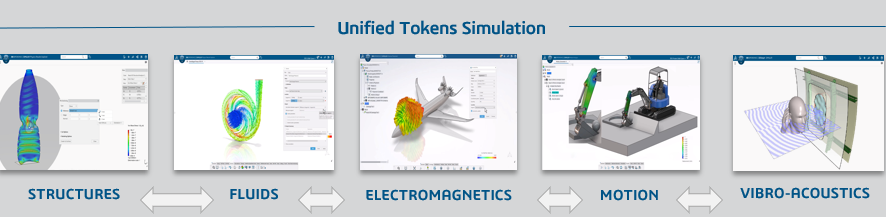
Is a direct answer to this. One solver token for All physics. Let's look at what that actually means in practice, and how it compares to the traditional approach.
Traditional vs. unified: side by side
A team running three disciplines (structural, electromagnetic, and fluid) under traditional licensing manages at least three separate token pools, three separate renewal cycles, and three separate budget line items. Here is what that same team looks like under the unified model across every dimension that affects their daily work.
Traditional vs. Unified Licensing
Solver Access
- Traditional: One token type per solver e.g. Abaqus tokens and CST tokens are completely separate
- Unified Licensing: One token pool shared across all solvers
Idle Resources
- Traditional: Tokens sit unused when a discipline is not active
- Unified Licensing: Any discipline draws from the shared pool on demand
Exploring New Physics
- Traditional: High upfront investment. New solver tokens required before you can even start
- Unified Licensing: Add only the front-end app; the token pool is already there
Peak Demand Handling
- Traditional: Jobs queue behind domain-specific license limits
- Unified Licensing: Credits cover burst demand so priority jobs never wait
Occasional Users
- Traditional: Designers and generalist engineers can't justify a dedicated seat
- Unified Licensing: Credit model is ideal, pay only when used, no waiting
Feature Completeness
- Traditional: Fragmented licenses often mean partial functionality per tool
- Unified Licensing: Full extended SIMULIA functionality unlocked across all domains & physics simulation.
Long-term Cost
- Traditional: License sprawl grows with each new discipline added
- Unified Licensing: Consolidation opportunity leads to fewer license types and lower overhead
What’s actually in the token pool
This is the part worth paying attention to, because the breadth of what a single SIMULIA token now unlocks is substantial. These are not lightweight tools filling gaps in the portfolio: most of them are market-leading solvers in their respective domains.
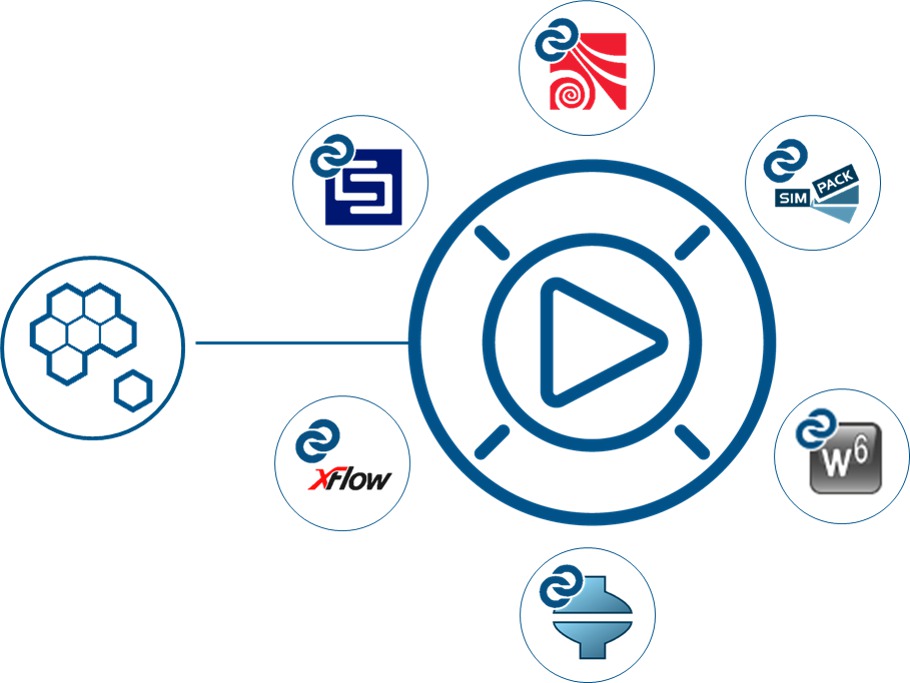
- Abaqus: Market leader in linear and nonlinear FEA. Includes fe-safe for durability and fatigue, and Tosca for topology and shape optimization. Scales from standard CPU to modern GPU architectures.
- Simpack: High-fidelity MBD for railway, automotive drivetrains, wind turbines, and aerospace mechanisms. Predicts loads, vibrations, and fatigue. Supports hardware-in-the-loop and real-time simulation.
- CST Studio Suite: Full-spectrum EM simulation from low-frequency power electronics to high-frequency antenna design. Multiphysics coupling with thermal and structural effects. Handles PCB to large-scale radar.
- PowerFLOW: Uses meshless Lattice-Boltzmann for aeroacoustics and complex flows.
- Wave6: Unique multi-method acoustic and vibration analysis across the full audible frequency range. Combines FEM, BEM, and SEA in one engine which is not possible in any other single tool on the market.
- Isight: Process automation and parameter optimization underlying all simulation disciplines. Enables full DOE, Monte Carlo, and optimization loops, the backbone of any multidisciplinary workflow.
Tokens vs. credits: knowing when to use each
The SIMULIA unified model introduces two consumption mechanisms, and understanding the difference is important for getting the most out of your license pool.
SIMULIA Tokens
Tokens determine how many cores you can run simultaneously on-premise or on-cloud. They are your steady-state capacity i.e. always available to your team, consumed per active solve. A typical mid- sized installation runs at 100 tokens, which can cover an Abaqus job on 8 cores, a PowerFLOW run on 128 cores, and a CST Studio process on 32 cores, all in parallel.
SIMULIA Credits
Credits work like a prepaid model, solving power available on demand when tokens are at capacity. This is what covers peak periods, so a high-priority job never has to wait in queue. Credits are also the right answer for designers and generalist engineers who need simulation occasionally but can't justify a dedicated token allocation.
The 3DEXPERIENCE® dimension
The unified token pool works both for SIMULIA standalone solver deployments and within the 3DEXPERIENCE® platform that adds a layer that standalone workflows can't replicate. When all simulation disciplines run inside a single data environment, the exchange of boundary conditions and results between solvers requires no scripting, no file management, and no data validation steps. Every stakeholder whether a structural analyst, CFD engineer, manufacturing process engineer, designer works from the same data model through dedicated apps. The Process Experience Studio app takes this further, allowing simulation experts to build web-based interfaces for non-specialists. A designer who needs to understand how a geometry change affects flow performance or structural response can configure and run a simulation through a purpose-built GUI, without needing to understand the underlying solver setup. The simulation expert defines the workflow once. Everyone else just uses it.
Is this the right move for your team?
Unified licensing makes most sense when at least one of the following is true:
- Your team runs more than one simulation domain and the token pools sit idle at different times.
- You want to explore a new physics domain without a large upfront commitment.
- You have occasional simulation users — designers, project engineers — who currently have no practical access to compute.
- You're running Multiphysics workflows that currently require manual data transfers between tools.
For any of the four cases above, fewer license types, higher utilization of the compute you already have, and a lower barrier to expanding into new physics, that's a combination worth taking seriously!
Ready to run the numbers for your setup?
An online assessment will show exactly how unified licensing maps to your current simulation portfolio and where the efficiency gains are. For that, Contact us here.
Author

Melad Fahed
Technical Director
Melad holds a Bachelor's and a Master's degree in Mechanical Engineering from Khalifa University. His expertise lies in Finite Element Analysis, parametric optimization, and additive manufacturing.